

Contact With us
2028, New York
contact@fufo.com
+1300 877 503
Call For Inquiry
+00 (002) 896 22
More Services
Women
Introduction
Sudan stems from a cultural heritage and value-based principles that emphasize gender equity and justice, honoring women and believing in the importance of their role as a fundamental pillar in the renaissance and construction of society. Sudanese women preceded their counterparts in neighboring countries, gaining the right to vote in 1954 and the right to run for office in 1964.
The first woman entered the Sudanese Parliament in 1964 while the percentage of women in the current parliament (2010) represents more than 25%. This remarkable leap came in accordance with the Elections Law, achieving a distinguished gain for Sudanese women by securing a 25% quota for women’s representation in Parliament and legislative councils.
The Interim Constitution of Sudan also granted women the right to participate in forming and joining political parties, trade unions, and professional and sectoral associations.This led all Sudanese political parties to include active female leadership within their executive and leadership bureaus. This inclusion empowered women to participate in making numerous political decisions.
Furthermore, the Transitional Constitution guaranteed the foundations for achieving social, economic, and political justice among all groups and regions, as well as between men and women, thereby fostering a secure and stable nation. It also reaffirmed the right to equal pay for equal work since the 1970s, and women achieved an equal retirement age to that of men. Additionally, the 1998 Constitution granted women the right to pass Sudanese citizenship to their children from a foreign spouse.
Sudan is among the first Arab and African nations to appoint women to the judiciary, with the number of female judges reaching 80. Women have also held senior positions in the civil service and the diplomatic corps, reaching the rank of Major General in the Army and Security Forces, and the rank of Lieutenant General in the Police.
The Political Experience of Women
Women participate significantly in public political life and decision-making positions, backed by civil and political rights guaranteed by the Constitution. They have also been active in various parliaments and legislative bodies in Sudan from 1956 to the present day.
Furthermore, women have assumed leadership roles within the Council.
- In the Third Constituent Assembly (1986), a woman held the position of Chairperson of the Education Committee.
- In the Transitional National Council (1994), a woman chaired the Social Affairs Committee.
- In the National Assembly (1994), women held positions as Chair of the Industry Committee, Chief Whip (Leader of Deliberations), and Chair of the Community Development Committee.
- In the National Assembly (2001), women served as Chair of the Peace Committee and Chair of the Community Development Committee.
Women have also participated in the executive branch:
- In labor unions, they have served on central committees and executive offices across 13 sessions.
- Within the judiciary, women have attained positions as judges and Supreme Court justices, with 7 female members currently serving on the Supreme Court.
Additionally, women have held roles such as Head of a Judicial Body, Public Prosecutor, and Consultant at the Attorney General's Office.
In the diplomatic corps, there are currently two female ambassadors and 17 diplomats, while in the police force, 927 female officers are currently serving.
Pioneers woman of sudan :
- Start of women's education history ( 1907)
- First cohort of female university students 1930
- First women's association ( 1943)
- First women's club ; Intellectual Girls' League ( 1947)
- First female doctors in Sudan: Dr. Khalda Zahir & Dr. Arwa ( 1953)
- First women's newspaper : Women's Rights Newspaper ( 1955)
- First Sudanese female broadcaster ( 1956)
- First Sudanese female singer with her own band and records: Aisha Al-Falatiya (1942)
- First Women’s Union: Sudanese Women's Union ( 1952)
- First female Member of Parliament: Ms. Fatima Ahmed Ibrahim (1965)
- Women gain the right to vote in elections ( 1953)
- Women gain the right to run for all political bodies ( 1964)
- First female member of a Constitution Drafting Committee: Thoraya Al-Dardiri ( 1953)
- First female judge in Africa and first female Supreme Court Judge: Maulana Ihsan Mohamed Fakhri ( 1976)
- First female State Governor: Ms. Agnes Lukudu ( 1991)
- First female Minister without Portfolio: Ms. Nafisa Ahmed Al-Amin ( 1971)
- First female Minister with Portfolio (Ministry of Social Affairs): Dr. Fatima Abdel Mahmoud ( 1973)
Statistics on Women's Representation in Sudan
- Legislative Branch : in the current Parliament: 78 female deputies (representing 25%).
- Executive Branch : ministers in the current government: 5 (Social Welfare, Labor, Parliamentary Affairs, Education, and Media).
- Judicial Branch : judges in senior positions: 89 judges.
- Public Prosecution : prosecutors and consultants in the Attorney General’s Office: 284 (representing 40% of prosecutors and public attorneys in Sudan).
Professional & Institutional Representation of Women
- Security & Diplomacy :
- Officers in the Police Force: 10%
- Among NCOs (Non-Commissioned Officers) and soldiers: 15%
- In the Diplomatic Corps: 7%
- Education & Legal Sector :
- In the legal profession (Lawyers): 41%
In the education sector: 69%
- Students in Higher Education (universities and institutes): 67%
- Civil Society :
- Number of branches of the General Union of Sudanese Women: 27,000 branches
Sudanese Women's Entities & Organizations
- General Union of Sudanese Women
- Business and Professional Women’s Union Club
- Businesswomen’s Secrétariat
- Small Productive Projects Development Association
- Women’s Secretariat of the Sudan Workers Trade Union Federation
- Working Women’s Association

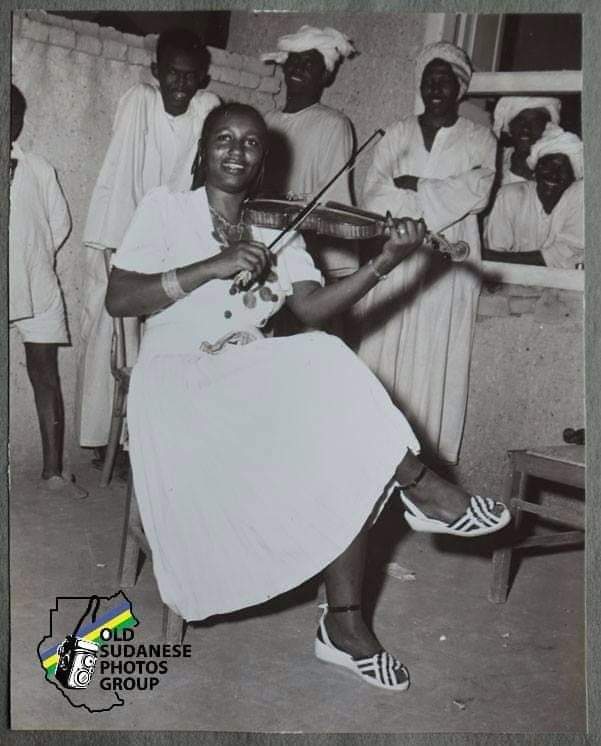
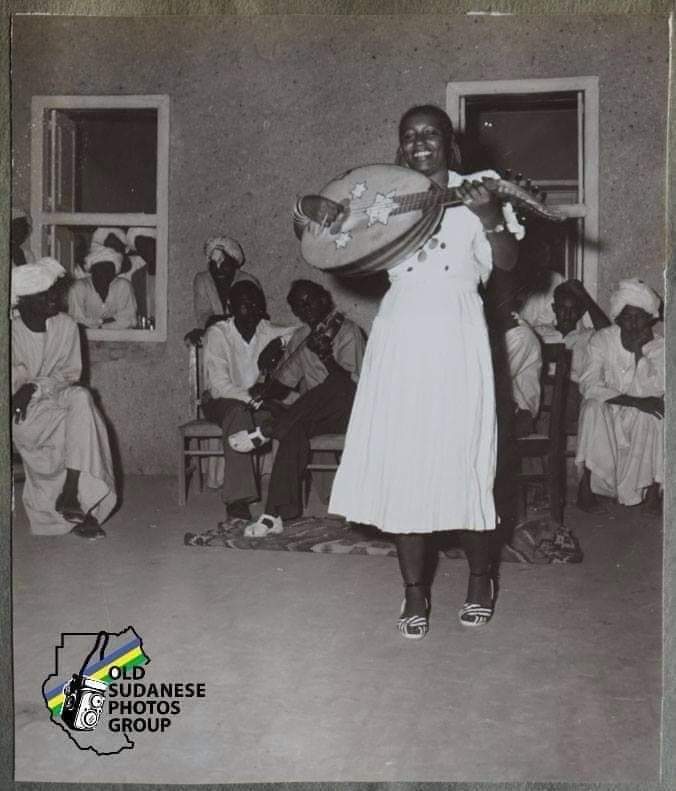
Saadia Al-Awadiya
She lived in Al-Hilla Al-Jadida in 1952. She was a versatile artist—both an instrumentalist and a singer—who performed at events accompanied by a full orchestra. She is the mother of Salwa, the inspiration behind Ibrahim Awad’s famous song: “Oh Salwa, what has my heart done?” (lyrics by Bashir Abdel Aal).
Many Sudanese songs, passed down through generations for their melodic sweetness, lyrical sobriety, and sincere emotions, have had “parody” lyrics composed to match their tunes. For instance, the song “The First Meeting” (also known as Aqbala Al-Layl) by poet Qurashi Mohammed Hassan and performed by Osman Hussain, contains the verse:
“My beloved, the night has descended upon us… we sipped its joys in succession until we were quenched.”
In the early 1950s, evening revelers adapted this melody with new lyrics: “Look at Yolanda singing to us with the Rababa… in grace and agility, they captivated us… Oh Rosina, Oh Rosina, offer hospitality to us.”
The story unfolds in Old Khartoum, in an alleyway nestled between Alhurria street (formerly Newbold) and Abdel Latif Street (formerly Ismail Pasha) located at the west of the current Othman Elias Building and west of the former Tourism and Hotels Authority offices. In this narrow lane, many Sudanese, Coptic, and Ethiopian families resided, including the family of the late Al-Haj Suleiman and the Andom family.
The patriarch of the Andom family worked in the office of the Governor-General of Sudan. One of his sons, Aman, joined the Ethiopian army and later led a military coup against Emperor Haile Selassie; he was eventually assassinated by his deputy, Tafari Benti, who was himself later assassinated by Mengistu Haile Mariam.
Living nearby in a house rented from Al-Amin Al-Shaar were the Sudanese singers Al-Radiya, Al-Tuma, and Saadia Al-Awadiya. They shared the residence with three exceptionally beautiful Ethiopian sisters: Yolanda, Slabona, and Rosina. These three sisters would accompany Saadia Al-Awadiya to her performances. Saadia was a consummate artist, performing with a full orchestra at weddings alongside giants like Abdel Hamid Youssef and Hassan Atteya. Notably, Saadia Al-Awadiya was likely the first woman to wear a formal women’s suit and the first to play the Oud behind her back (symbolizing high technical mastery and charisma) —a performance style later adopted by the international referee Ahmed Qandeel.