Contact With us
2028, New York
contact@fufo.com
+1300 877 503
Call For Inquiry
+00 (002) 896 22
More Services
Civilization and History
Ancient Civilizations of Sudan
Sudan has known civilizations since 300 BC, characterized by strong ties between the Nubian regions in the north and the Egyptian state of that era. During this period, the influence of Egyptian kings extended to include northern Sudan. In the 8th century BC, the Kingdom of Napata emerged in the north. It grew in power and expanded its influence to southern Egypt; its first king was Kashta (760–750 BC), whose reach extended north to the city of Thebes in Egypt.
In 750 BC, Piye (Piankhi), son of Kashta, became King of Nubia. He advanced northward until the borders of his kingdom reached the Egyptian Delta. He was succeeded by his son Taharqa, who was famous for massive construction projects, building temples, and focusing on agriculture. He also succeeded in organizing trade and left behind many archaeological tablets. The Nubian rule of Egypt ended in the mid-7th century BC at the hands of the Assyrians.
Kingdom of Meroe
Ancient Meroe is located on the east bank of the Nile near the current Kabushiya station (50 km north of Shendi in River Nile State). This city rivaled Napata as an important commercial and cultural center until it eventually took the lead. Meroe’s borders extended from the First Cataract to the borders of Ethiopia, reaching as far south as the modern-day city of Sennar. It was home to pyramids, temples, and palaces.
The rule of the Meroitic kings in Sudan ended around 350 AD at the hands of the Ethiopian Kingdom of Aksum.
The Christian Nubian Kingdom
Christianity entered Nubia via Egypt, where the city of Thebes was a major center for Christian mission work. The credit for Christianity's entry into Nubia goes to Emperor Justinian and his wife Theodora, who sent Father Julian to Nubia in 543 AD. The Christian kingdoms in Sudan were represented by Nobatia, Makuria, and Alodia (Alwa).
The Entry of Islam into Sudan
Islam entered Sudan via the Red Sea in the east, through Egypt in the north, and through tribes entering from the west. Muslims continued to enter Sudan, spreading Islam and building mosques.
Muslims conquered Egypt in the 7th century AD and spread Islam there. During the era of the Governor of Upper Egypt, Abdullah bin Abi al-Sarh, he sent his army to Sudan due to repeated raids from the south on his borders. The battle ended with a truce. However, with the renewal of raids, another army was sent in 651 AD, penetrating as far as Old Dongola, the capital of the Christian state of Makuria. This campaign ended with the signing of the famous peace treaty known as the "Baqt." The agreement provided the Nubians with security and peace in exchange for maintaining the mosque built in Dongola and protecting Muslims.
The Blue Sultanate (1505–1821 AD)
At the beginning of the 16th century, an alliance was formed between the Funj, led by Amara Dunqas, and the Abdallab, led by Abdullah Jamma (from the Qawasmeh Arabs). They succeeded in establishing the first Arab state in Sudan, known as the Blue Sultanate or the "Funj Kingdom." Sennar was established as its capital, while the Abdallab resided in the north of the Sultanate with their capital in "Qerri" (the current site of the oil refinery in the Al-Gaili area, north of Khartoum).
The Sultanate of Fur and the Kingdom of Tegali
When the Kingdom of Sennar was established in 1505 AD, it opened the door for Islamic kingdoms in Sudan. The Sultanate of Fur was founded in 1637 AD with its capital at El Fasher in western Sudan. In the Nuba Mountains, the Kingdom of Tegali was established in 1530 AD, maintaining its independence until the early 17th century. The Fur Sultanate continued until 1916 AD, and its last ruler was Sultan Ali Dinar.
Turco-Egyptian Rule in Sudan (1821–1885 AD)
The Turkish era in Sudan began when the ruler of Egypt, Muhammad Ali Pasha, invaded and occupied Sudan in 1821 AD to exploit its vast resources. The invaders met great resistance from the Sudanese, but the military imbalance led to the success of the campaign. This era saw Khartoum become the capital of Sudan. However, the Sudanese suffered from heavy taxes and a sense of wounded national dignity under foreign rule, providing the catalyst for the Mahdist Revolution, which overthrew Turco-Egyptian rule in 1885 AD.
The Mahdist State (1885–1898 AD)
The Mahdist Revolution and the resulting state are sources of pride for the Sudanese people. This revolution was not only joined by Muslims in Northern Sudan but also by tribes from the West and South to restore national dignity and achieve independence. Led by Imam Muhammad Ahmad al-Mahdi and his successor, Khalifa Abdallahi al-Ta'ishi. Al-Mahdi passed away in 1885 AD, and the Khalifa took over, establishing an independent national state governed by Islam. The capital was moved from Khartoum to Omdurman. The state ended following the British invasion and the declaration of the Anglo-Egyptian Condominium in 1899 AD.
British-Egyptian Rule (1898–1956 AD)
The Anglo-Egyptian Condominium began in 1898. The British were the actual rulers, while the Egyptian presence was nominal, despite the Egyptian flag flying alongside the British one. The administration was led by the Governor-General, followed by three Administrative Secretaries (Administrative, Judicial, and Financial), then provincial governors. Sudan was divided into seven provinces.
National Rule
The Revolution of Abdel Qader Wad Haboba
This revolution arose in the rural area of Al-Mahiereba in central Sudan (Al-Halawiyyin region) in 1908 AD as an extension of the Mahdist Revolution. However, the British captured and executed Wad Haboba, ending his revolt.
The Revolution of Ali Dinar (1916 AD)
When the British took over Sudan, the Kingdom of Fur was not initially under their control. Sultan Ali Dinar, a supporter of the Mahdist Revolution, returned to Darfur and governed it until the British attacked him. He fought them until his defeat in 1916 AD, at which point the British annexed Darfur.
The 1924 Revolution
Sudanese resistance evolved as education spread and the country opened up to the outside world. Secret organizations were formed, such as the Sudanese Union Society (1921). In 1924, the White Flag League emerged, calling for the unity of the Nile Valley and independence for both Sudan and Egypt. In the same year, students of the Military School in Khartoum clashed with the colonial army in an unequal battle. Many became martyrs, most notably the hero Abdul Fadel Al-Maz, who died after the building he was in was demolished over him. Other symbols included leader Ali Abd al-Latif (from the Dinka tribe), who was imprisoned along with Obaid Haj al-Amin; both died in prison. The British eventually suppressed the revolution.
The Graduates' Congress and the Birth of Political Parties
The "Graduates' Congress" emerged in the early 1940s, starting as a cultural and social movement before evolving into the voice of the Sudanese nation against British colonialism. It submitted memoranda demanding a greater role for Sudanese in managing their affairs. This was followed in the mid-1940s by the birth of Sudanese political parties, most notably the Umma Party and the Ashiqqa Party, along with various Islamic and political ideological parties.
Recognizing the Sudanese desire for self-determination, the British began making concessions that led to Sudan's independence.
National Rule (1956–1958 AD)
Several governments followed independence. The First Parliamentary Period lasted from January 1, 1956, to November 1958, based on the 1956 Constitution and the British system. The government was first led by Ismail al-Azhari, followed by Abdullah Khalil.
The First Military Rule (1958–1964 AD)
This era ended with the coup of November 17, 1958. A military council took power for six years, during which parties were dissolved and a Central Council was established as a legislative body. This rule ended with the October Popular Revolution in 1964.
The Second Parliamentary Period (1965–1969 AD)
A short transitional government followed (1964–1965) led by Sirr Al-Khatim Al-Khalifa. This was followed by the governments of Mohamed Ahmed Mahgoub and Sadiq al-Mahdi. The Head of State during this time was Ismail al-Azhari.
In October 1964, the first popular revolution against a military regime in post-independence Africa occurred. Only five years later, Colonel Gaafar Muhammad Nimeiry led another military coup in May 1969. He ruled for 16 years until the Rajab/April Revolution of 1985, led by Field Marshal Abdel Rahman Swar al-Dahab, who handed power to an elected government in 1986.
The "May" Rule Period (1969–1985 AD)
Party rule ended on the morning of May 25, 1969, with the May Coup that brought Gaafar Nimeiry to power. He managed the country for 16 years under a presidential republic system, with the People's Assembly as the legislative authority. His rule ended with the April Uprising in 1985.
The Third Parliamentary Period (1986–1989 AD)
Following the end of the May regime, a one-year transitional period occurred under a military council led by Field Marshal Abdel Rahman Swar al-Dahab. In 1986, elections led to a Constituent Assembly and a government headed by Sadiq al-Mahdi. The Head of State was a five-member council chaired by Ahmed al-Mirghani. This era ended with the National Salvation (Ingaz) coup on June 30, 1989.
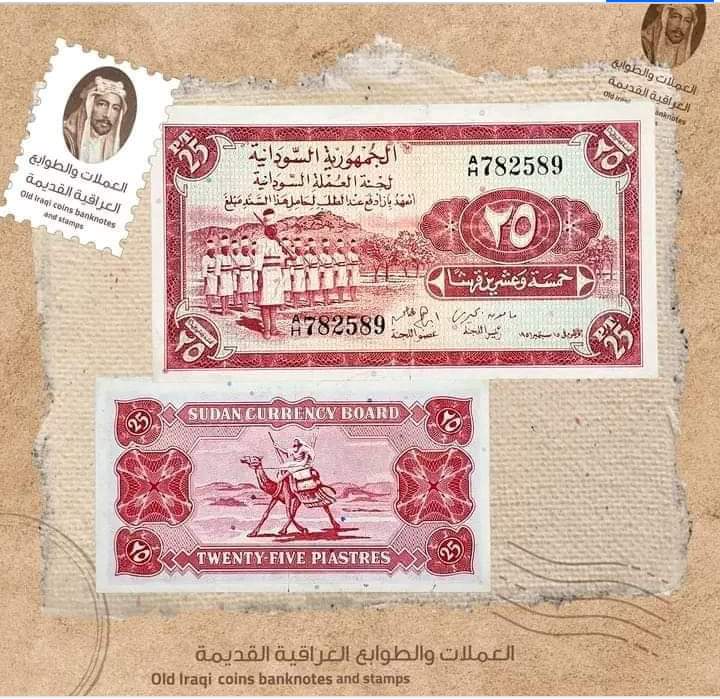
Sudan Currency Board
25 Piastres
- First issue of Sudanese currency.
- Khartoum, September 15, 1956.
Front:
Image of Sudanese soldiers.
Back:
The famous postman on a camel.
Signature:
Mamoun Beheiry, the first Chairman of the Currency Board.